
VIX Hits 40 as AI Selloff Deepens: Panic or Opportunity?
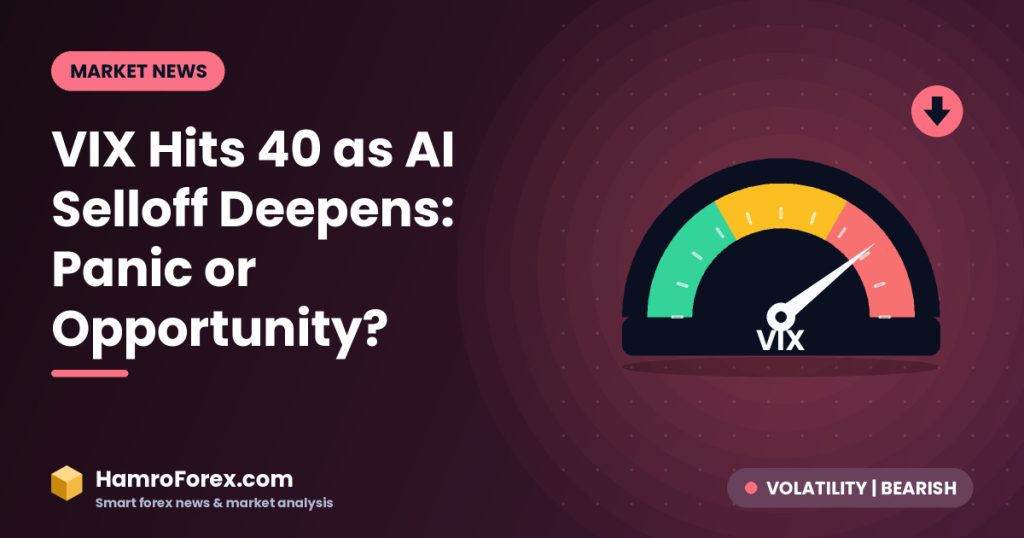
The Cboe Volatility Index, Wall Street’s fear gauge, closed Friday at 35.89 after briefly touching 40.03 during the session. That marked its highest level since the April 2025 tariff turmoil. The jump came as the S&P 500 confirmed a correction and the Nasdaq erased its 2026 gains in an AI-driven selloff.
The Dow and S&P 500 both confirmed corrections while the Nasdaq marked its worst week since 2020 reuters.com
— Reuters (@Reuters) November 21, 2026
What happened
The VIX finished Friday at 35.89, up 26.2% on the day from Thursday’s 28.44 close, according to Cboe data. It hit an intraday high of 40.03. Bloomberg reported the gauge touched 40 late in the session as stocks extended their slide. Reuters noted earlier that it had climbed above 30 for the first time in seven months amid AI concerns.
The S&P 500 fell 3.70% to 6,910.39, entering correction territory after a seventh straight loss. The Nasdaq Composite dropped 5.28% to 22,617.73, wiping out its year-to-date gain. Nvidia led the damage, plunging about 13.8% on reports of an SEC review of its accounting practices. Anthropic shares continued to fade toward their $83 IPO price.
Fed Governor Lisa Cook said in remarks that the current policy rate is not high enough to deal with inflation levels she views with great concern, reinforcing hike expectations for the December meeting.
Market reaction
Risk assets sold off hard. Spot gold fell roughly 3% to around $3,516, its lowest since September 2025, as the dollar held firm near 19-month highs and traders priced higher rates. Bitcoin dropped below $60,000 for the first time since July, trading near $58,800–$59,000 in some feeds.
USD/JPY retreated toward 158.70 as the yen strengthened on haven demand. The dollar index stayed near 103.89. Oil held up better, with Brent settling near $92.57–$92.63 and WTI around $83.70, supported by Middle East supply concerns even as equities tumbled.
Treasury yields eased, with the 10-year falling back below 5% in some reports as money rotated into bonds.
Why it matters for traders
A VIX above 30 signals elevated fear and higher expected swings in the S&P 500 over the next 30 days. Touching 40 puts it in stressed territory, levels last seen during the tariff shock. Traders who sold puts or ran low-vol strategies suddenly faced bigger hedges and margin pressure.
The move ties directly to the AI valuation reset. Neither strong Nvidia earnings earlier nor Anthropic’s record IPO stabilized sentiment. Instead, concerns about returns on data-center spending, an SEC probe, and sticky inflation with Fed officials signaling more hikes compounded the selling. Gold and Bitcoin failed to act as safe havens, both sliding with equities as liquidity dried up.
For forex traders, the dollar’s resilience and yen’s bounce highlight the classic risk-off pattern. Check the economic calendar for next week’s data that could shift rate odds further.
Key levels / what to watch next
Watch whether the VIX holds above 30 or fades back toward 25. Sustained readings near 35–40 often coincide with continued equity pressure until a catalyst stabilizes sentiment. On the S&P 500, the 6,900 area is the immediate line after the close at 6,910. A break lower would deepen the correction.
For gold, $3,500 is the next psychological support after the drop below $3,550. Bitcoin’s hold above $58,000–$60,000 will be key. In FX, USD/JPY support near 158.50–158.70 could see further yen strength if stocks keep falling. The December Fed meeting and any fresh AI or tariff headlines remain the main drivers.
Traders can track levels with tools like the risk calculator and review recent moves in the trading journal.
Key Takeaways
- VIX closed at 35.89 after touching 40.03, highest since April 2025.
- S&P 500 entered correction with a 3.7% drop; Nasdaq erased 2026 gains with a 5.28% plunge.
- Gold hit multi-month lows near $3,516; Bitcoin fell below $60,000.
- Fed officials including Cook reinforced expectations for further rate hikes.
- Watch VIX 30–40 zone, S&P 6,900, and gold $3,500 for next signals.
This article is for information only and is not financial advice.
Learn more: who we are · the risk disclaimer · contact us.
Educational content, not financial advice. Leveraged trading can lose more than your deposit.

Discussion
0 commentsNo comments yet. Start the discussion below.