5 Uncomfortable Truths About Trading Most Gurus Won’t Tell You
Last updated
If you have scrolled through social media recently, you have likely seen the ads: a 22-year-old leaning against a rented supercar, promising a 90% win rate” strategy. They sell a vision of financial freedom where you replace your 9-to-5 by clicking buttons for an hour a day while sitting poolside.
The reality is far more sobering. Trading is arguably the hardest “easy money” job in the world. To survive, you have to look at the cold data, not the dopamine hits. Here are five uncomfortable truths about trading that separate the surviving 1% from the 99% who eventually blow up their accounts.
You Will Lose Money More Often Than You Think
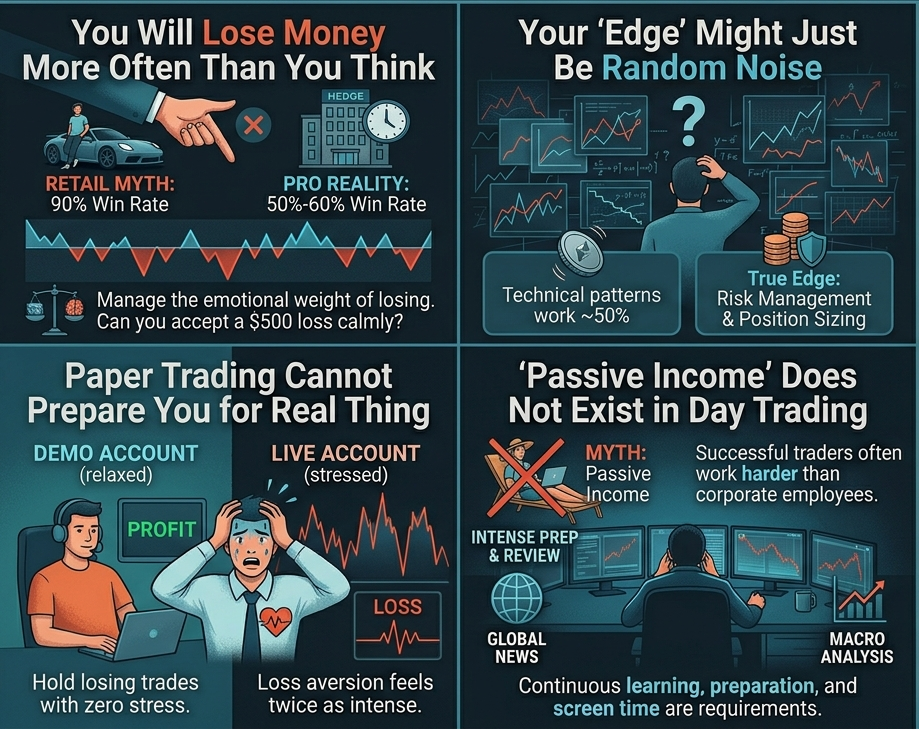
Professional hedge funds and elite institutional traders often win only 50% to 60% of their trades. Despite this, retail beginners frequently expect to win 80% or 90% of the time.
Most new traders quit not because their strategy is broken, but because they cannot handle the emotional weight of losing. You can be a highly profitable trader while being wrong half the time. The market is indifferent to your confidence. If you cannot accept a 500 dollar loss with the same stoic calm as a 500 dollar win, you simply will not survive the long game.
Your “Edge” Might Just Be Random Noise
In a highly efficient market especially in Forex and major indices price movements are largely stochastic (random) in the short term.
Many traders spend months “optimizing” their moving averages, convinced they have cracked a secret code. In reality, they have often overfitted their strategy to past data that will never repeat in exactly the same way. The uncomfortable truth is that most technical patterns work about 50% of the time no better than a coin flip.
True “edge” does not come from a magic indicator it comes from position sizing and risk management. If you remove the risk management from a winning strategy, it becomes a losing one. Conversely, if you apply rigorous risk management to almost any logical entry, you have a chance at profitability.
The Market Actively Hunts Your Stop Losses
This isn’t a conspiracy it is basic market mechanics. Large institutions, banks, and high-frequency algorithms have a bird’s-eye view of the “order book. They know exactly where the masses place their stop losses usually just a few pips below the most obvious swing lows or support levels.
Algorithms are programmed to push prices just low enough to trigger those stops, collecting your liquidity to fill their own large orders, before reversing hard in the direction you originally predicted. If you place your stop loss at the most “logical” or obvious level, you are essentially donating money to the institutions. To survive, you have to place stops in “ugly” areas or use volatility-based measures like the Average True Range (ATR).
Paper Trading Cannot Prepare You for the Real Thing
Paper trading is excellent for learning how to use your platform, but it is a terrible teacher for learning how to manage yourself.
In a demo account, you can hold a losing trade for days until it turns around, and you feel like a genius. But in a live account, when your actual savings are on the line, biology takes over. Your heart rate spikes, and adrenaline clouds your judgment. You will find yourself exiting winning trades too early out of fear and holding losing trades too long because you cannot face the ego hit of being wrong.
Psychological studies on “loss aversion” prove that humans feel the pain of a loss twice as intensely as the joy of a gain. Paper trading simply cannot replicate that neural chemistry.
Passive Income” Does Not Exist in Day Trading
The idea of “set it and forget it” passive income through day trading is a myth sold by those who make more money from courses than from the markets.
Scalping and day trading are high-performance activities. They require hours of intense, stress-inducing screen time. You cannot do this successfully from a beach with spotty Wi-Fi. If you want true passive income, the S&P 500 or real estate are your best bets.
Successful traders often work harder than corporate employees. They spend hours preparing before the London or New York sessions open analyzing economic calendars and geopolitical news and more time reviewing their trade journals after the market closes. If you are looking for a “lifestyle business” that requires zero effort, trading is not the answer. It is a profession of elite discipline.
Learn more: who we are · the risk disclaimer · contact us.
Educational content, not financial advice. Leveraged trading can lose more than your deposit.