Can AI Predict the Markets in 2026? What Every Trader Needs to Know
Can AI predict the markets in 2026? It’s the question every serious trader is asking right now and the honest answer is more nuanced than either the hype or the skeptics suggest. AI-powered trading systems have made genuine leaps in capability over the past two years. Yet markets remain one of the most hostile environments any algorithm has ever tried to conquer. This guide cuts through the noise and tells you exactly where AI stands, what it can do for your trading, and where it still falls dangerously short.
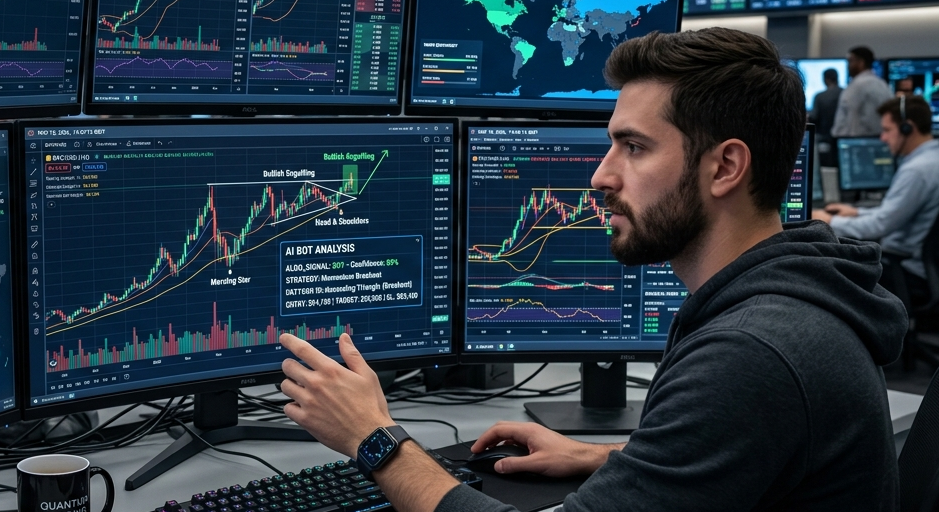
What AI Trading Bots Can Actually Do in 2026
Modern AI trading bots go well beyond the simple rule-based scripts of five years ago. Today’s systems combine large language models (LLMs), reinforcement learning, and real-time data ingestion to do things no human trader can match at scale.
Pattern recognition at machine speed
AI can scan thousands of assets simultaneously, identify statistical patterns across historical price data, and execute trades in microseconds. Institutional firms now use transformer-based models similar in architecture to the models that power modern chatbots to detect subtle correlations between assets that a human analyst would need weeks to find.
Sentiment analysis and news parsing
One of the most commercially viable AI applications in trading is real-time sentiment analysis. Bots can parse central bank statements, earnings transcripts, geopolitical news, and social media feeds simultaneously, then score the probable market impact before most humans have even read the headline. In 2025, Bloomberg reported that hedge funds using NLP-driven sentiment layers outperformed pure quantitative models by an average of 4.3% on risk-adjusted returns.
Backtesting and strategy optimization
AI dramatically accelerates the strategy development cycle. What used to take a quant team three months to back test across 10 years of data can now be done in hours. Genetic algorithms and Bayesian optimization allow bots to iterate through thousands of strategy variations to find statistically robust entries, exits, and risk parameters.
Why Most AI Trading Bots Still Fail
For all their promise, the failure rate among retail AI trading bots remains alarmingly high. Understanding why helps you avoid costly mistakes.
Overfitting: the silent killer
The most common cause of bot failure is overfitting when a model is trained so closely on historical data that it “memorizes” past noise rather than learning genuine patterns. A bot that shows 80% win rate in back testing may collapse immediately when deployed on live markets, because real price action is non-stationary and constantly evolving.
Black swan events and regime changes
Markets can shift regimes overnight a pandemic, a central bank pivot, a geopolitical shock. AI models trained on pre-2020 data were largely blind to the COVID crash. Models trained on 2020–2022 data overweight volatility that no longer exists. Without continuous retraining and regime detection, even a well-designed bot will degrade.
Lack of true causality
AI finds correlations. It does not understand causality. A model may learn that oil prices correlate with CAD/USD during certain periods but when OPEC changes policy or the energy transition shifts global demand, that correlation breaks without warning. No amount of data alone can teach a model why markets move the way they do.
What AI does well
- 24/7 market monitoring
- Emotion-free execution
- Multi-asset correlation
- Speed and consistency
- Rapid backtesting
Where AI falls short
- Adapting to regime shifts
- Understanding causality
- Handling black swans
- Generalizing to new data
- Replacing human judgment
Check Forex News Feed: CLICK HERE
Can AI Trading Bots Beat Human Traders?
In high-frequency, data-rich environments yes, consistently. In discretionary macro trading that requires geopolitical intuition, cultural context, or reading central bank tone rarely. The research is clear: AI trading bots outperform humans on execution quality, but human discretionary traders still hold an edge in interpreting unprecedented events.
A 2024 MIT study found that hybrid strategies where an AI handles execution and risk management while a human sets the macro framework produced Sharpe ratios 31% higher than either approach alone. This is the practical model most serious traders are now moving toward.
How Retail Traders Are Using AI for Forex & Crypto Trading
The democratization of AI tools has reshaped what’s possible for individual traders. Here’s what’s actually working at the retail level in 2026:
Practical steps for retail traders
- Start with AI-assisted analysis, not full automation. Tools like Trend Spider, Trade Ideas, and Auto Chartist use AI to surface high-probability setups, letting you make the final decision. This hybrid approach preserves your edge while reducing analysis time by 60–70%.
- Use AI for risk management, not just entries. AI-powered position sizing tools which factor in volatility, correlation, and account drawdown in real time are where retail traders see the most consistent improvement in account longevity.
- Validate bot performance on out-of-sample data. Never deploy a bot based solely on in-sample backtest results. Walk-forward testing across at least 2–3 different market regimes is the minimum standard for any strategy you plan to trade live.
- Monitor for model decay actively. Set up performance dashboards with alerts. If a bot’s win rate drops more than 10% from its historical average over a 30-day window, pause it and investigate before losses compound.
The Biggest Risks of Using AI Trading Bots
Understanding risk is where most retail traders fail. Here are the risks you must account for before deploying any AI system:
- Execution slippage: Backtests assume perfect fills. Live markets don’t. Slippage can erode a strategy’s edge entirely, particularly in less-liquid pairs or during news events.
- Data snooping bias: If you’ve tested 200 strategy variations on the same dataset, the “best” performer is probably just the one that got lucky. This is a statistical certainty, not a theory.
- Broker and API risk: A bot is only as reliable as its connection. API downtime, broker requotes, or latency spikes can turn a winning strategy into a losing one without warning.
- Overconfidence from strong backtests: Past performance is structurally misleading in markets. A 10-year backtest covering 2013–2023 missed COVID, the 2022 bond crash, and the crypto collapses. No backtest captures the future.
- Regulatory exposure: In 2025, ESMA and the SEC both increased scrutiny of algorithmic retail trading. Know the regulatory environment in your jurisdiction before automating.
Can AI Trading Bots Pass Prop Firm Challenges?
This is one of the most searched questions in the AI trading space right now. The short answer: some can, but most don’t and using a bot to pass a prop firm challenge without disclosure may violate their terms of service.
Prop firm challenges typically require consistent daily gains within strict drawdown limits over 30–60 days. AI bots optimized for this time frame tend to overfit to that specific challenge format, then fail immediately during the funded phase when market conditions shift. Several leading prop firms have now deployed their own AI detection systems to identify bot-generated trading patterns particularly suspiciously consistent lot sizing and entry timing.
If you’re pursuing a prop firm challenge, the strongest approach remains a human-led strategy supported by AI risk tools not a fully autonomous bot.
What AI Trading Bots Still Can’t Do in 2026
Despite the rapid advances, there are fundamental limits that no current AI system can overcome:
- Predict genuinely novel events. AI is trained on what has happened. It cannot anticipate a true black swan an event outside the distribution of anything in its training data.
- Understand market microstructure at a human level. Experienced traders develop an intuitive sense of order flow, liquidity traps, and institutional behavior that current AI models cannot replicate from price data alone.
- Adapt autonomously and safely. Giving an AI full autonomy to retrain itself in production is a recipe for catastrophic drawdown. Retraining requires human validation at every cycle.
- Replace risk management judgment. Position sizing, correlation risk, portfolio heat these require contextual judgment that goes beyond any formula an AI can currently learn.
So, can AI predict the markets in 2026? Not with certainty and any system claiming otherwise should be treated with deep skepticism. What AI can do is meaningfully improve your probability of success: faster analysis, more disciplined execution, better risk management, and the ability to process information at a scale no human can match.
Learn more: who we are · the risk disclaimer · contact us.
Educational content, not financial advice. Leveraged trading can lose more than your deposit.