Why Should Traders Keep a Trading Journal? 5 Proven Benefits
Last updated
Why should traders keep a trading journal? Discover how tracking trades improves discipline, reduces emotional errors, and boosts long-term profitability.
Why Should Traders Keep a Trading Journal? The Data Backed Habit That Separates Winners from Losers
If you have been trading for any length of time, you have likely asked yourself: why should traders keep a trading journal when platforms already track profit and loss automatically? The answer lies in a simple truth that separates consistently profitable traders from those who spin their wheels for years. Your platform shows what happened. Only a journal reveals why it happened.
Consider this. The human brain is a storyteller, not a statistician. It naturally over remembers wins, minimizes losses, and rewrites history to protect your ego. Without a structured record, you are trading with distorted feedback. Every professional trader I have interviewed at Hamroforex.com confirms the same pattern. Their breakthrough came not from discovering a secret indicator. It came from the self awareness that journaling created.
Key Insight: Traders who journal consistently report improving their performance up to twice as fast as those who do not. That is not marketing fluff. It is the natural result of converting random experience into structured learning.
What Is a Trading Journal and What It Is Not
A trading journal is far more than a profit and loss statement. While your broker’s dashboard shows your account balance, a proper journal captures the full context of every trading decision.
A trading journal includes:
- The trade mechanics including entry, exit, position size, stop loss, and take profit levels
- The strategic context including setup type, timeframe, market conditions, and your rationale for entering
- The psychological snapshot covering your emotional state before, during, and after the trade
- Visual evidence via chart screenshots showing exactly what you saw at entry and exit
- Post trade analysis covering what went well, what went wrong, and what you learned
A trading journal is NOT:
- Just a spreadsheet of numbers
- A place to vent frustration without analysis
- Something you fill out once and never review
As noted by experienced traders, almost every successful institutional or full time trader maintains some form of journal. This is not coincidence. It is infrastructure for consistent performance.
How Does a Trading Journal Help Traders Improve?
When you ask experienced traders how does a trading journal help traders improve, the answer always circles back to one concept. Feedback loops. Without a journal, you are essentially trading blind. You rely on memory that psychology research confirms is unreliable for objective performance tracking.
1. It Reveals Hidden Patterns You Would Never Notice Otherwise
After logging 50 to 100 trades, patterns emerge that memory alone could never surface. You might discover that your Asian session trades consistently underperform your London session trades. Or that trades taken after two consecutive wins have a significantly lower success rate.
A futures trader I know discovered through journaling that his reversal setups had a 34 percent win rate. His trend continuation setups won 61 percent of the time. He had been allocating equal capital to both. Six months after reallocating based on journal data, his equity curve transformed completely.
2. It Exposes Risk Management Leaks
One of the most dangerous phenomena in trading is “risk creep.” This is the gradual increase of position sizes without realizing it, especially after a winning streak. A trading journal makes this immediately visible. When you see your risk per trade climbing from 1 percent to 2.5 percent over two weeks, you can correct course before a single bad trade wipes out weeks of gains.
3. It Accelerates Learning Exponentially
Every trade becomes a data point for improvement rather than just another entry in your account history. When you document why you entered, you can later evaluate whether that reasoning was sound regardless of outcome. This prevents the dangerous mental shortcut of judging decisions solely by their results.
Is Trade Journaling Really Necessary for Beginners?
Many new traders ask: is trade journaling really necessary for beginners? The honest answer is that beginners need journaling more than experienced traders do. Yet they are the least likely to maintain one.
Here is why beginners benefit most:
- It prevents years of repeating the same mistakes. Without documentation, you will likely make the same error dozens of times before recognizing the pattern.
- It builds discipline from day one. Trading rewards process followers, not thrill seekers.
- It creates an honest baseline. You cannot improve what you do not measure.
A new trader at Hamroforex.com shared that after three months of consistent journaling, she identified that her biggest losses all occurred within 60 minutes of waking up before she was mentally sharp. Simply shifting her trading start time by one hour eliminated 40 percent of her losing trades.
What Are the Benefits of a Trading Journal?
When traders ask what are the benefits of a trading journal, they are often surprised by how far the advantages extend beyond simple record keeping.
Psychological Benefits
Emotional Pattern Recognition
Your journal becomes a mirror reflecting emotional triggers you may not recognize in real time. Common patterns include:
- Revenge trading after a loss by entering without setup confirmation
- Premature profit taking due to fear by exiting before targets are hit
- Overtrading when bored by forcing setups in quiet markets
- Euphoric overconfidence after wins by increasing size inappropriately
One trader noted that when a trade had low liquidity, he started getting anxious and looking for any viable exit even though his original thesis was still valid. This awareness is impossible without documentation.
Reduced Emotional Decision Making
Simply knowing you will have to record and review each trade creates accountability. Traders report that this “observer effect” helps them follow their plans more consistently.
Performance Benefits
Strategy Refinement
Your journal answers critical questions:
- Which setups actually print money versus which just look good on charts?
- What time of day do you perform best?
- What is your true win rate on each strategy type?
Statistical Confidence
When you know your main setup wins 48 percent of the time with an average 2.3R reward, a three loss streak does not shake your confidence. It is within expected statistical variance. Without this data, every losing streak triggers self doubt and strategy hopping.
Edge Preservation
Markets evolve. Strategies that worked last year may underperform today. A journal provides early warning signals when your edge is deteriorating. This allows proactive adjustment rather than reactive account damage.
How to Use a Trading Journal Effectively
Knowing how to use a trading journal effectively is the difference between busywork and breakthrough. Many traders fill pages with notes but never extract actionable insights.
The Three Layer Tracking Framework
Professional traders track across three dimensions:
1. Technical Data: What Happened on the Chart
- Setup type and market conditions
- Entry and exit prices and timing
- Risk to reward ratio at entry
- Maximum Adverse Excursion (how far price went against you)
- Maximum Favorable Excursion (how far price moved in your favor)
2. Behavioral Data: How You Executed
- Did you follow your trading plan exactly?
- Did you enter early or chase price?
- Did you move your stop loss for emotional reasons?
- Did you take partial profits according to plan?
3. Emotional Data: Your Internal State
- Confidence level before entry (rate 1 to 10)
- Anxiety level during the trade (rate 1 to 10)
- Any FOMO, hesitation, or frustration present
- Post trade emotional state
Weekly Review Protocol
Recording trades is only half the equation. Schedule 30 to 60 minutes weekly for review:
- Calculate key metrics: Win rate, average R multiple, expectancy
- Categorize losses: Strategy failure versus discipline failure versus market anomaly
- Identify one recurring mistake to eliminate next week
- Identify one strength to lean into more heavily
Pro tip: Use the formula Expectancy = (Average Win × Win Rate) minus (Average Loss × Loss Rate). A positive expectancy means your process works even if your win rate is below 50 percent.
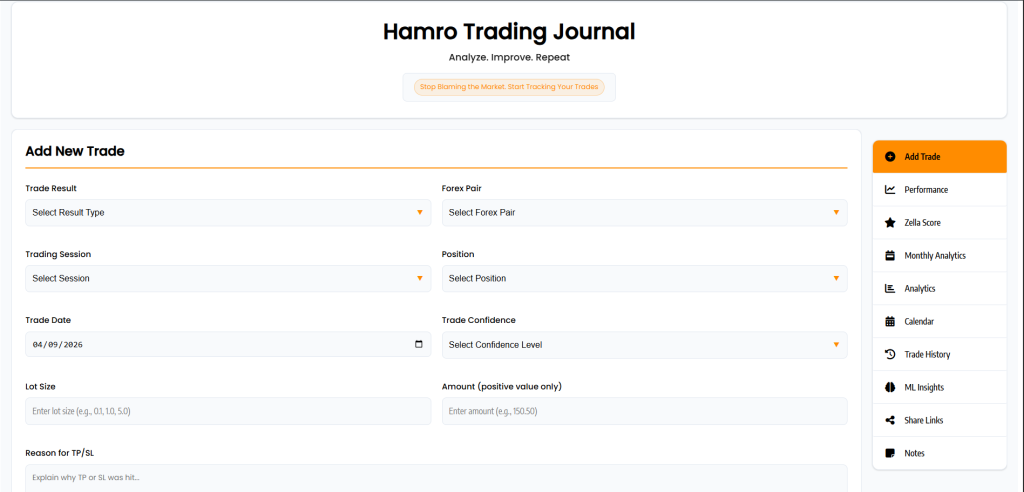
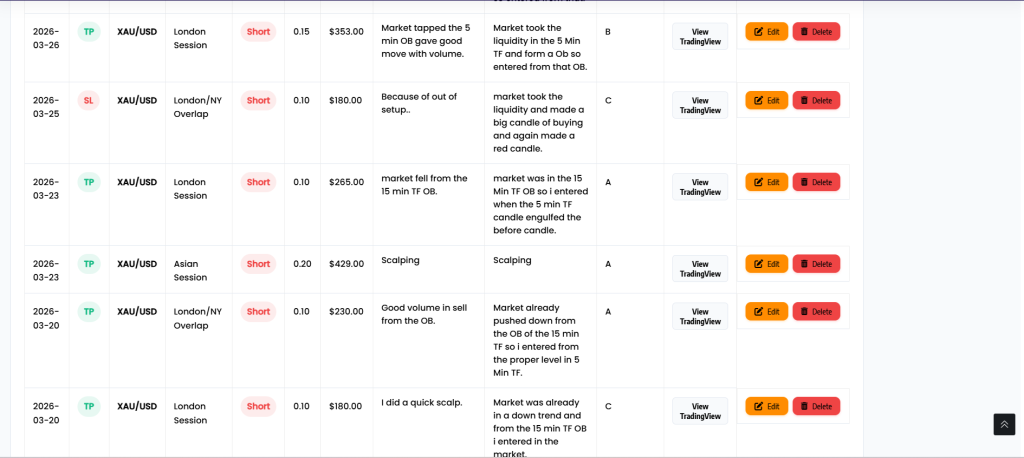
Simple Starting Template
Do not let perfectionism prevent progress. Start with this minimal framework:
| Field | Example Entry |
|---|---|
| Date and Time | Jan 15, 10:30 AM |
| Instrument | EUR/USD |
| Direction | Long |
| Entry Price | 1.0945 |
| Stop Loss | 1.0920 (25 pips) |
| Take Profit | 1.0995 (50 pips) |
| Position Size | 1 percent risk |
| Setup Type | Support bounce plus RSI divergence |
| Emotional State | Calm, focused (7 out of 10) |
| Outcome | Plus 50 pips (plus 2R) |
| Lesson | Waited for candle close confirmation which was worth it |
Does Journaling Improve Trading Psychology?
Does journaling improve trading psychology? This question gets to the heart of why journals matter. The answer, based on both trader experience and behavioral research, is unequivocally yes. But not in the way most people expect.
Journaling does not eliminate emotions. Fear, greed, and hope will always be part of trading. What journaling does is create space between stimulus and response. When you document that you felt FOMO before chasing a breakout, you create a reference point. The next time that feeling arises, you can recognize it and pause.
The Accountability Effect
Traders who journal report a fascinating phenomenon. The act of knowing you will document a trade changes how you approach it. You are less likely to take that impulsive “YOLO” position when you will have to explain it to your future self during weekly review.
Building Emotional Resilience
Reviewing past trades, especially winning ones, during drawdown periods provides objective evidence that you know what you are doing. This prevents the destructive spiral of self doubt that leads to strategy abandonment.
As one market analyst noted, your journal is the notebook that turns pain into lessons.
Why Do Professional Traders Keep Journals?
When we ask why do professional traders keep journals, the answer reveals something fundamental about trading itself. Professionals do not journal because it is fun. They journal because trading without measurement is trading blind.
Think of it this way. Would an Olympic sprinter train without a stopwatch? Would a chess grandmaster play without recording and analyzing games? The idea seems absurd. Yet retail traders routinely risk real capital without any performance tracking beyond their account balance.
Professional traders use journals to:
- Maintain their edge. Markets evolve, and journals provide early detection when strategies lose effectiveness.
- Manage multiple strategies. When running several systems simultaneously, journals track which are performing and which need adjustment.
- Satisfy institutional requirements. Many prop firms and funds require detailed trade documentation for risk management compliance.
At Hamroforex.com, our most successful community members treat their journals as proprietary databases. They are collections of personal market insights that no one else can replicate.
How Trading Journal Helps in Risk Management
Understanding how trading journal helps in risk management is crucial because risk control is the foundation of longevity in trading.
Detecting Risk Creep
Risk creep, which is gradually increasing position sizes without conscious awareness, is a silent account killer. A journal makes this trend immediately visible. When you see your average risk per trade climbing from 1.2 percent to 2.1 percent over a month, you can reset before disaster strikes.
Identifying High Risk Behaviors
Journal analysis reveals behavioral patterns that increase risk exposure:
- Trading during high volatility news events without adjustment
- Removing stop losses after price moves against you
- Doubling down on losing positions, also known as averaging down
- Taking trades that do not meet your minimum risk to reward threshold
Building a Statistical Safety Net
When you have hundreds of logged trades showing your true win rate and expectancy, you can calculate appropriate position sizing with mathematical precision. This prevents both overconfidence by risking too much after wins and fear based trading by risking too little when edge is present.
Practical Steps to Start Your Trading Journal Today
Step 1: Choose Your Format
- Beginners: Google Sheets or Excel is free, customizable, and easy to analyze
- Intermediate: Notion offers visual dashboards and screenshot integration
- Advanced: Dedicated platforms like Edgewonk or TraderSync provide automated import and advanced analytics
Step 2: Commit to 100 Percent Documentation
No cherry picking. Every trade gets logged, especially the ugly ones you would rather forget. Incomplete data leads to misleading conclusions.
Step 3: Schedule Non Negotiable Review Time
Block 30 minutes every weekend for journal review. Treat this like a meeting with your most important client: yourself.
Step 4: Turn Insights into Rules
When you spot a recurring issue, create a specific rule to address it. For example: “I overtrade after two consecutive losses. New rule: After two losses, I step away for 30 minutes minimum.”
So why should traders keep a trading journal? Because trading is one of the few professions where you can lose money for years without ever understanding why unless you document your journey. A journal transforms random market exposure into structured learning. It converts emotional decisions into data driven processes. Most importantly, it reveals the trader you actually are, not the one you imagine yourself to be.
Your trading platform tells you your account balance. Your journal tells you whether you are becoming a better trader. One measures outcomes. The other measures growth.
Frequently Asked Questions
1. Is a trading journal worth the time investment?
Absolutely. Traders who journal consistently report accelerating their learning curve significantly. The three to five minutes spent documenting each trade pays dividends through avoided mistakes and identified strengths.
2. Can I just use my broker’s trade history?
Broker statements show what happened including entries, exits, and profit and loss. They do not capture why you took the trade, what you were thinking, or what you learned. A journal provides the context that transforms data into wisdom.
3. What is the best format for a trading journal?
There is no single “best” format. Beginners should start simple with Google Sheets or Excel. As you develop consistency, tools like Notion, Edgewonk, or TraderSync offer more advanced analytics and automation.
4. How often should I review my trading journal?
Schedule a weekly review session of 30 to 60 minutes for recent trades and a monthly deep dive for pattern analysis. Consistency matters more than duration.
5. What if journaling reveals I am a consistently losing trader?
This is actually good news. You now have data to identify exactly what is breaking. Focus on eliminating your most expensive mistake first. Many traders discover that fixing just one recurring error transforms their results.
6. Should I include screenshots in my journal?
Yes, whenever possible. A chart screenshot showing your exact entry and exit points provides context that written notes alone cannot capture. It is invaluable during review sessions.
7. How long before I see results from journaling?
Most traders notice improved self awareness within two to three weeks. Measurable performance improvement typically emerges after one to three months of consistent documentation and review.
Learn more: who we are · the risk disclaimer · contact us.
Educational content, not financial advice. Leveraged trading can lose more than your deposit.